

Dealers don't renew your contract. Consumers do. And the claims experience you deliver is either your strongest sales tool, or the reason the next VSC goes to someone else.
There’s a conversation that happens inside almost every F&I administrator’s business that goes something like this:
- How do we keep dealers happy?
- How do we keep dealers selling our products?
- How do we make the dealer relationship stickier?
It’s the right conversation, because dealers are the distribution channel and growth doesn’t happen without them.
But there’s a person who almost never gets named in that conversation. The one who handed over money for the VSC, the GAP policy, and the paint protection. The one sitting in the service lane right now, waiting to find out if their $4,000 transmission repair is covered. The one who, in about 48 hours, is going to tell everyone they know whether this product was worth buying.
The consumer. Almost entirely absent from strategic conversation. And that’s a mistake that compounds quietly, — until it doesn’t.
What the consumer actually bought
When someone purchases a vehicle service contract, they’re not buying a document. They’re buying a promise. Specifically: if something breaks and it’s covered, someone will take care of it quickly, fairly, and without making me feel like I must fight for what I paid for. That promise gets tested exactly once in a way that matters, the first time they file a claim.
Think about the emotional state of that moment:
- Their car is in the shop.
- They may be without transportation.
- They’re already stressed.
- And now they’re waiting, for a phone call, for an authorization, for someone to tell them what’s covered and what isn’t.
Every hour of that wait is the product delivering or failing. Not the coverage terms. Not the price they paid at the dealer. The experience of getting the claim resolved.
Most F&I administrators have optimized their operations entirely around internal efficiency metrics, cost per claim, adjuster utilization, and approval rate. All legitimate. All important. Almost entirely disconnected from what the consumer is experiencing on the other end of that claim.
The first claim is the product. Everything before it is just a sale.
Why the dealer feels it first
Here’s the mechanism that makes consumer experience a dealer problem, not just a customer service problem.
When the claims experience breaks, the customer doesn’t call you:
- They call the dealer. And now the dealer owns a problem they didn’t create, from a product they recommended.
- Or they walk into the dealer for their next service visit and mention it.
- Or they leave a review.
- Or they tell the friend who’s currently car shopping where not to buy a warranty.
The dealer who sold that VSC now has a customer who’s upset with a product the dealer recommended. That’s a trust problem. And dealers have long memories about which products create trust problems and which ones don’t.
The F&I managers at that dealership start steering customers toward a different provider — not because of a formal decision, not because of a contract change, but because the path of least resistance is to recommend something they don’t have to apologize for later. That shift happens quietly, deal by deal, until the volume numbers start moving, and nobody’s quite sure why.
This is the hidden churn mechanism in this industry. Not contract non-renewals. Not price competition. Consumer experience eroding dealer confidence, one claim at a time.
The administrator with the fastest, clearest, most consumer-friendly claims process isn’t just winning on experience — they’re winning on dealer retention without ever having to ask for it.
What AI changes about this equation
The reason this has been a hard problem to solve is structural. The claims process has historically been labor-intensive, document-heavy, and slow by nature. You couldn’t make it dramatically faster without dramatically increasing headcount, and even then, you hit quality ceilings.
AI removes that constraint. And when you think about what that means for the consumer, it changes the product entirely.
Imagine a VSC claim where:
- The consumer calls in; the IVR captures the basic information conversationally — VIN, mileage, nature of the repair, and routes it intelligently before they hang up.
- The claim is open with complete information.
- The repair estimate arrives by email and is read, structured, and compared against coverage terms and median pricing automatically.
- The adjudicator sees a detailed breakdown with a suggested decision and the reasoning behind it.
- Authorization goes back to the shop within hours, not days.
- The consumer receives an email. Repair authorized. Expected completion: tomorrow.
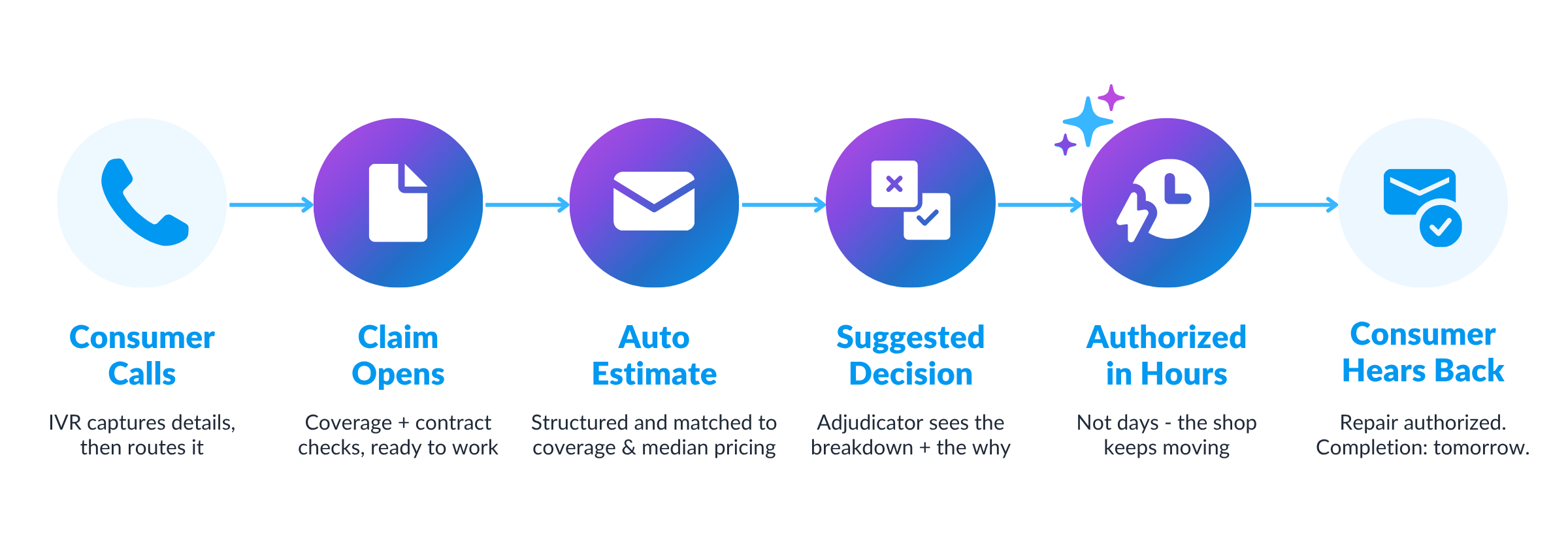
That’s not a fantasy. That’s what an AI-embedded claims operation looks like at maturity. And from the consumer’s perspective, that experience doesn’t feel like insurance. It feels like someone built this product with them in mind.
Now run that same scenario against a competitor still operating on a manual intake process, a two-day adjudication queue, and a status line that puts callers on hold. Same coverage. Same Price. Radically different product.
Same coverage terms. Same price. Radically different product. The difference is entirely in the experience of using it.
Speed is table stakes. Transparency is the differentiator.
I want to push past speed for a moment, because I think it’s where the real opportunity sits.
Consumers in the claims process don’t just want resolution. They want to know what is happening.
Anxiety isn’t just about the outcome. It’s about silence:
- Not knowing whether anyone is working on it.
- Not knowing if there’s a problem.
- Not knowing whether the shop has what they need.
Proactive communication — a text when the claim is received, an update when it’s under review, a clear message when it’s approved with exactly what’s covered and what the consumer owes — transforms the emotional experience of a claim without changing the outcome at all.
This sounds simple. It is technically simple once the underlying workflow is instrumented properly. But it requires an AI-enabled claims platform that tracks claim state in real time and triggers communications automatically. Legacy systems don’t do this. Not because it wasn’t a good idea twenty years ago — but because the architecture was never built for it.
The administrators who figure this out first won’t just have happier consumers. They’ll have a product story that no competitor can match without rebuilding from the ground up.
The business case closes itself
Let me put the revenue logic plainly, because it’s worth stating directly.
A consumer who has a fast, fair, transparent claims experience does several things:
- They renew. Often at higher rates, regardless of price. The data on this is consistent across the extended warranty and service contract industry; customers who had a positive claims experience renew at significantly higher rates than those who didn’t.
- They also refer. The friend who asks “is that warranty worth it” gets a real answer from someone who used it.
- And critically, they go back to the dealer who sold them the product with a positive feeling instead of grievance. That dealer now has a customer who trusts their recommendations. That’s worth more to a dealership than the margin on any individual F&I product.
The administrator who can demonstrate consumer satisfaction data; claim resolution time, communication scores, renewal rates tied to claims experience, has a dealer conversation that none of their competitors can have. It’s not “our coverage is competitive.” It’s “our customers come back, and they tell your other customers to buy from you.”
That’s a different category of value proposition. And it’s entirely unlocked by taking the consumer seriously as a stakeholder in the claims process, not an afterthought.
Renewal rates, referral rates, and dealer trust all move together. The variable connecting them is whether the consumer felt taken care of when it mattered. That moment is the claim.
The F&I industry has spent decades optimizing the sale. The next decade belongs to the administrators who optimize the experience. The technology to do it exists right now. The question is who moves first.
Where PCMI comes in
At PCMI, we’ve built around one principle: The claims experience is the product. Our PCRS Platform with Claims Intelligence gives administrators the tools to deliver the kind of claims experience that turns one-time buyers into repeat customers, skeptical dealers into advocates, and a cost center into a growth engine.
If you want to see what this looks like inside your workflow, not a demo, but a working model — let’s talk.
A conversation specific to your current claims workflow, your dealer network, and what your consumer experience data is telling you, whether you’re measuring it yet or not.
The administrators who win the next decade aren’t the ones with the best coverage terms. They’re the ones whose customers never have a reason to shop elsewhere.