
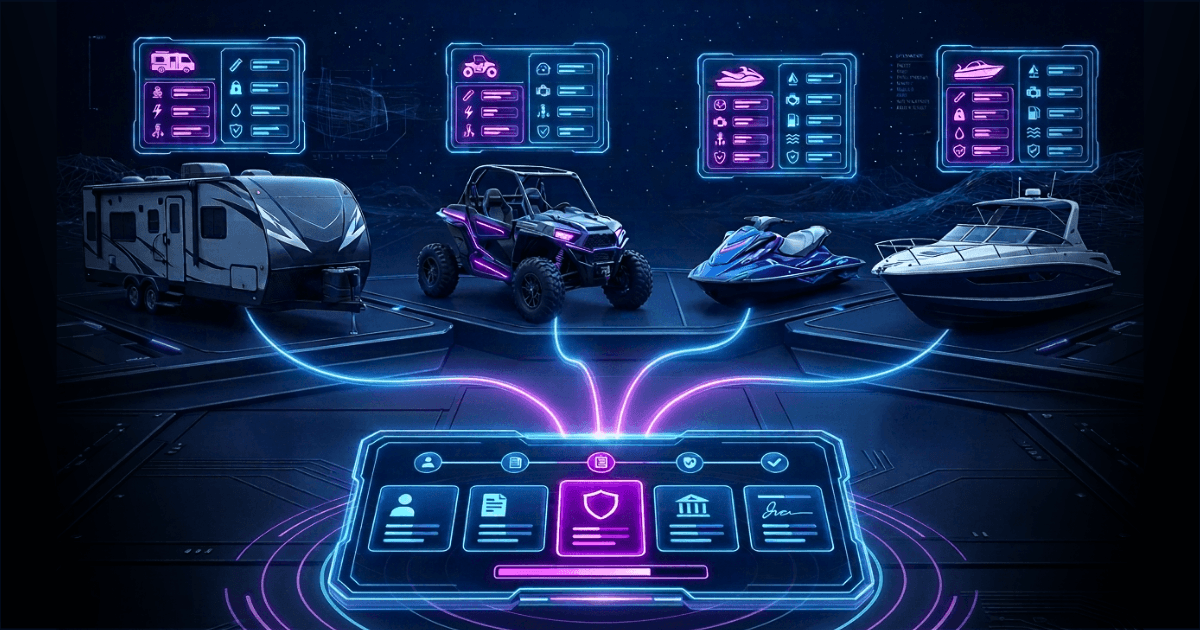
S pecialty F&I has a vehicle data problem that traditional automotive F&I technology was never designed to solve. In automotive, the process starts from a relatively predictable point: identify the vehicle, decode standardized information, determine eligibility, return rates, and move the deal forward.
Specialty retail is different.
An RV, motorcycle, ATV, UTV, boat, or personal watercraft may require a different combination of information before a protection product can be accurately rated. Year, make, model, purchase price, mileage, engine information, vehicle type, and other attributes may matter depending on the unit and the administrator’s program.
That leads to an important distinction for the industry:
A consistent F&I experience does not require every vehicle to fit the same data model.
Why RV, powersports and marine F&I require different vehicle data
Automotive has trained the industry to think of vehicle identification as a relatively standardized process. Enter the VIN and much of the information required for the transaction can follow.
Specialty vehicles challenge that assumption.
- An RV may require a different set of attributes than an ATV.
- A marine transaction may depend on information that has little relevance to a motorcycle.
- Even within a single specialty category, administrators may have different requirements for determining eligibility and calculating rates.
The issue is not that specialty vehicles are somehow less structured.
The issue is that their structure is different.
Problems arise when technology treats those differences as exceptions instead of designing for them from the beginning. That is when fields get repurposed, information gets manually entered, separate data sources are consulted, and employees know which workaround applies to which type of unit. Over time, the workaround becomes the workflow.
Specialty F&I should standardize the experience, not the inputs
There is a better way to think about consistency. Instead of requiring every transaction to begin with the same data, F&I technology should determine what information is necessary for the vehicle being sold and the protection product being rated.
- For one unit, that might mean Year, Make, and Model.
- For another, additional vehicle attributes may be required.
- The fields needed to calculate a rate may also be different from the information required later to complete a contract.
Those differences should happen behind the process, not become the process.
Different data in. Consistent F&I process out.
Once the necessary vehicle information is captured, the user experience can become much more familiar:
- Identify the unit
- Retrieve applicable rates
- Select products
- Build the transaction
- Complete the contract
That distinction matters for multi-category dealerships.
A dealer selling RVs, powersports, and automotive units should not need completely different F&I processes simply because the underlying vehicle data changes. Likewise, a TPA supporting multiple specialty segments should not have to force every program into one rigid automotive structure just to create consistency across its dealer network.
Specialty data can become infrastructure
There is also a larger opportunity here. When specialty vehicle information is structured consistently, it becomes more than data used to produce a rate. It becomes infrastructure.
Administrators can define the information required for different vehicle types. Dealers can work from a common process. New Year, Make, and Model information can extend the available data foundation over time. Rating and contracting can operate from the same underlying understanding of the unit.
That is a fundamentally different approach from asking specialty retailers to adapt themselves to systems built primarily around automotive transactions.
Solutions such as PCMI’s PresentNow reflect this direction by combining curated specialty-vehicle data, configurable rating inputs, and VIN and specialty-vehicle workflows in one connected F&I experience.
The broader lesson is more important than any one platform.
Specialty F&I does not need one universal vehicle data model. It needs technology flexible enough to understand different vehicles while giving dealers and TPA’s one consistent way to do business.