
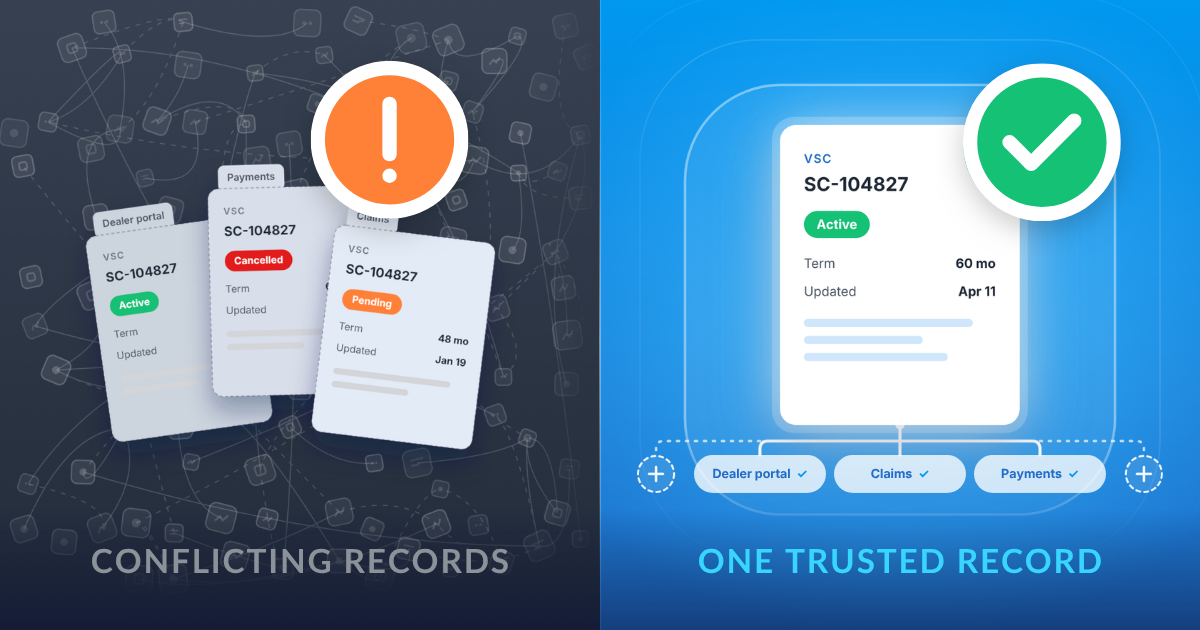
Point solutions solved problems. They also created a new one.
F or years, enterprise software strategy rewarded specialization. Need a new workflow? Add a tool. Need analytics? Add another platform. Need a portal, payment capability, data service, or automation layer? Connect something else.
That approach can be useful, and specialized tools are not going away. But there is a downside. The more systems a business adds, the harder it can become to answer a basic question: Which system has the correct record?
That is why the F&I system of record is becoming strategic again.
Across industries, software portfolios keep growing. MuleSoft’s 2026 Connectivity Benchmark reports that the average enterprise manages 957 applications, but only 27% are connected.[1]
957
27
BetterCloud found that organizations were already using an average of 106 SaaS applications in 2025, and 70% of surveyed IT professionals said they preferred a unified platform for managing and optimizing their SaaS stack.[2]
106
in the company
70
The takeaway for F&I is not that companies should stop using specialized software. It is that every new tool increases the value of having a trusted core.
F&I has too many moments where the record matters
A service contract does not sit still after it is sold. It can be rated, issued, remitted, amended, cancelled, reinstated, claimed against, paid, reported, and reconciled over its life.
A lot of people may touch that process. Dealers, administrators, agents, lenders, repair facilities, customers, insurers, and accounting teams can all interact with part of the same contract.
When those groups rely on different records, the problem is not just another login. It can show up as:
- mismatched contract status
- duplicate entry
- payment questions
- reporting differences
- unclear ownership
- time spent figuring out which system has the right answer
That makes the system of record a business issue, not just an IT preference.
The question is not whether an F&I organization should use specialized tools around the core platform. It should. The question is whether those tools are working from a trusted record or creating their own version of the truth.
AI makes the core more important, not less
This gets even more important as companies add AI and agentic workflows. Automated systems can act faster than people, but speed only helps when the data, business rules, permissions, and transaction history underneath them are reliable.
MuleSoft reported in 2025 that 95% of surveyed IT leaders had challenges connecting AI to existing systems, and 83% said integration issues were slowing their efforts.[3] In the 2026 benchmark, 82% cited data integration as one of their biggest AI challenges.[1]
95
83
That is a useful warning for F&I. The industry does not need every new intelligent tool to maintain its own interpretation of a contract, claim, dealer, payment, or coverage decision.
A strong system of record gives those tools a governed place to read from and write back to. It keeps the transaction history, business rules, permissions, and audit trail in one place even as new capabilities are added around it.
A strong core should create flexibility
Calling the system of record strategic does not mean building a closed environment. In fact, the opposite is more useful.
A modern core should make it easier to connect specialized applications, distribution partners, data providers, portals, analytics tools, and future technologies through APIs and structured data exchange. The center stays consistent while the edges can change.
That shifts the buying question. Instead of asking only, “Does this application solve today’s problem?” leaders should also ask, “What happens to our operating model after we connect ten more tools like it?”
This is why administrators are increasingly looking for a common operating foundation that connects contracts, claims, payments, and reporting rather than adding another isolated application.

That is the architecture PCMI has built PCRS around: a configurable administration platform that maintains a shared system of record while connecting to the broader F&I ecosystem through integrations, APIs, data pipelines, and role-specific experiences.
F&I will keep adding smarter technology. The value of that technology will depend on how trustworthy the core remains.