
It’s time to break free
Built in-house or bought years ago—it got you here. But it won’t take you further.
More products, more partners, more integrations, AI-driven capabilities, and higher expectations are changing what businesses need from their administration technology.
AI may make software faster to build, but operating a business-critical administration platform still requires ongoing investment in security, compliance, integrations, infrastructure, data, and product development. For many organizations, the question is no longer whether they can maintain their own system, but whether they should.
Why teams are moving on
Whether you built your own system or rely on aging legacy software, the challenges are strikingly similar. These platforms weren’t built for today’s expectations—and while they once gave you control, they now introduce complexity, risk, and overhead.
Why outdated systems can’t keep up:
Limited IT bandwidth
Internal teams are stretched thin, juggling maintenance, enhancements, and support tickets. Strategic work often takes a back seat.
Outdated infrastructure
Older platforms may not have been built for today’s cloud-first environments, making them more difficult to upgrade, integrate, and adapt as business needs evolve.
Security and compliance gaps
Keeping pace with evolving security, monitoring, auditability, and compliance requirements can require significant internal resources.
Missing modern capabilities
AI is accelerating how quickly software can be developed, but keeping an administration platform current involves more than writing code. Security, compliance, integrations, data governance, infrastructure, and continuous product development all require ongoing investment.
Disconnected data
Disconnected systems can create reliance on spreadsheets, manual uploads, and fragmented reporting to stay on top of your business.
Limited scalability
Legacy systems strain under added volume, users, or partners, making growth harder to sustain.
Constrained revenue growth
Legacy systems require heavy lifting to support new products, bundling, or dealer-specific programs limiting revenue potential.
Hidden costs
From additional hires to patch fixes and delays in product launches, the true cost of maintaining an internal system adds up quickly.
Before converting, we felt frustrated and handcuffed—our legacy system slowed our business and progression down a lot.
Jerry Munselle
President, Torque Group
Why the shift is accelerating
Digital transformation isn’t a future goal anymore. It’s already expected. Across the F&I product and service contract space, providers are rethinking their operations to keep pace with:
- AI-powered claims and workflow automation
- Real-time data and reporting
- Embedded payments and digital claims
- Connected dealer and partner ecosystems
- Predictive insights and analytics
- End-to-end digital experiences
And the gap between what legacy systems can offer and what your customers demand? It’s only getting wider.
The systems that win are built for change
F&I administration is evolving fast. Providers are expanding into digital channels, launching bundled products, and integrating with more partners than ever before. That kind of agility requires more than just a solid foundation. It demands a platform that can adapt quickly, scale as your business grows, and deliver real-time visibility across your ecosystem.
The systems leading the market aren’t just keeping up, they’re setting the pace. They’re built to evolve, enabling new programs, smarter workflows, and better experiences for every stakeholder involved.
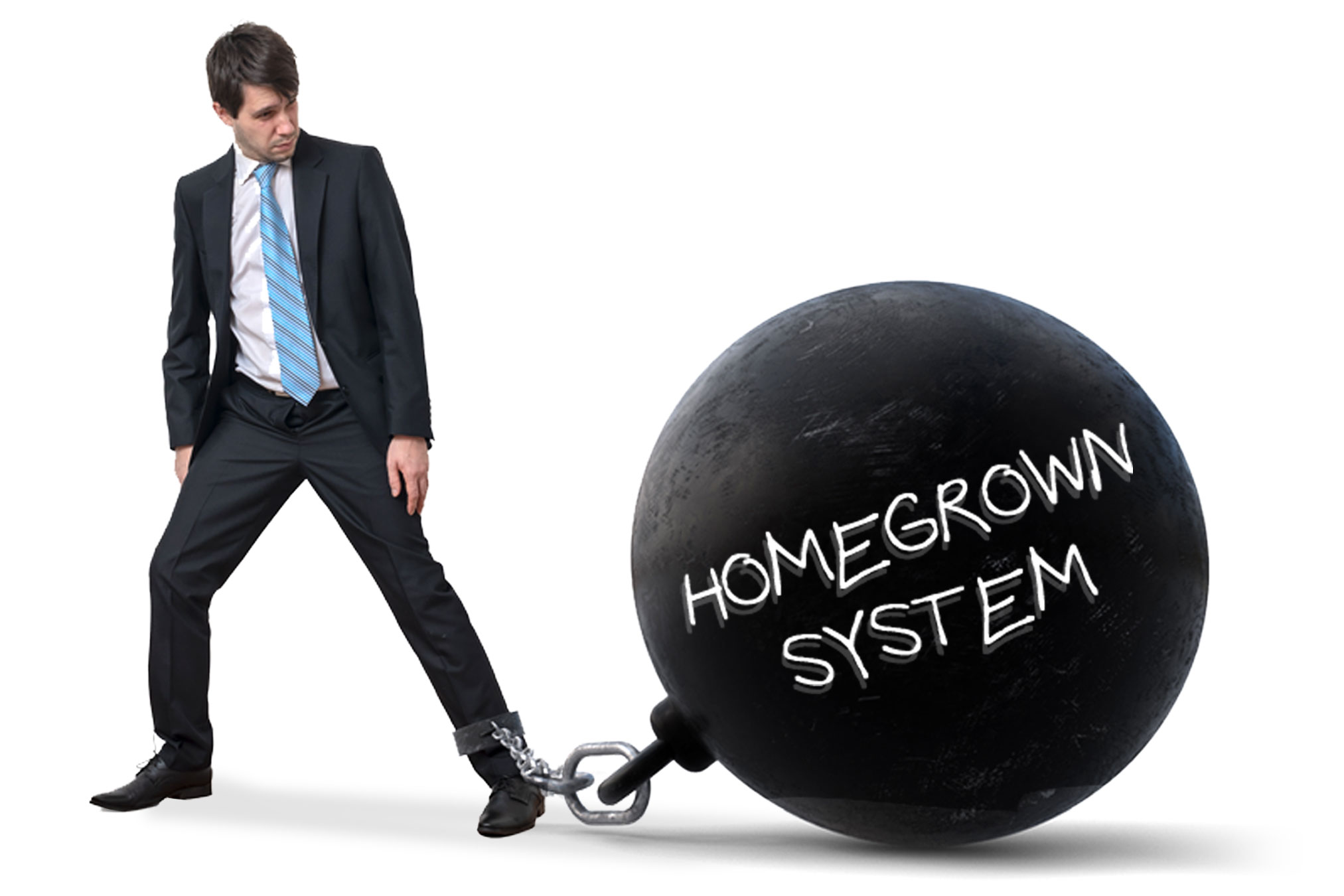
Maintaining a system means carrying the weight alone
Maintaining your own system means your team is responsible for keeping pace with every new requirement, integration, security need, and technology shift.
A modern administration platform can take some of that burden off your team, freeing resources to focus on your business, your customers, and what comes next.
Why choose PCRS?
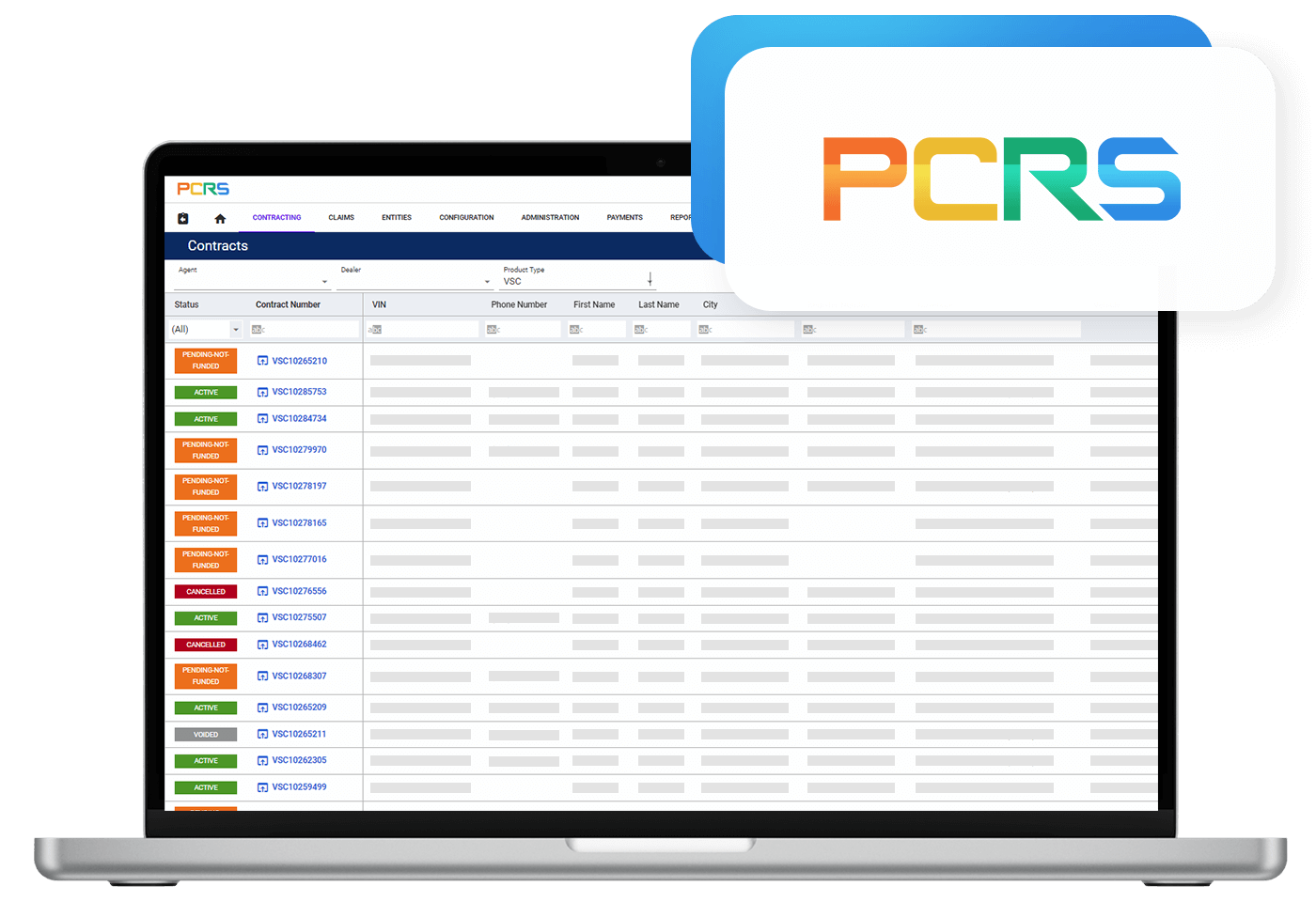
At PCMI, we built our Policy Claim and Reporting Solutions™ (PCRS) platform to help F&I administrators, OEMs, and dealers modernize and scale—all without losing control.
Our platform is trusted to process over 181 million contracts and 53 million claims for some of the most advanced operations in the industry. Backed by more than 115 prebuilt integrations and deep domain expertise, PCRS simplifies the complex while powering your entire lifecycle—from product launch to reporting.
With PCRS, you can:

Streamline contracts and claims end to end
Use AI and intelligent automation to reduce manual claims work
Automate invoice validation and payments
Launch and iterate on new programs faster
Integrate with dealers, partners, and service providers
Gain real-time visibility across your operations
Migration is complex. Experience makes a difference.
Switching systems isn’t easy, but it doesn’t have to be painful.
Our team follows a proven process to map, validate, and convert your data with accuracy and care. We’ve handled large-scale migrations from a wide range of homegrown and legacy systems, each with unique structures, formats, and challenges.
Whether you’re bringing over decades of contracts, claims, or rate tables, our team brings experience navigating complex data conversions and an approach designed to minimize disruption throughout the transition.
One of the things that attracted us to PCMI is that they had already taken clients that were on the same legacy system as us and converted them to PCRS. They understand the database and the structure.
Jeff Robinson
COO, Alpha Warranty
The bottom line
Your internal or legacy system got you this far. But to grow from here, you need more.
PCRS gives you the flexibility, automation, and support to modernize operations and compete in today’s fast-moving market.